

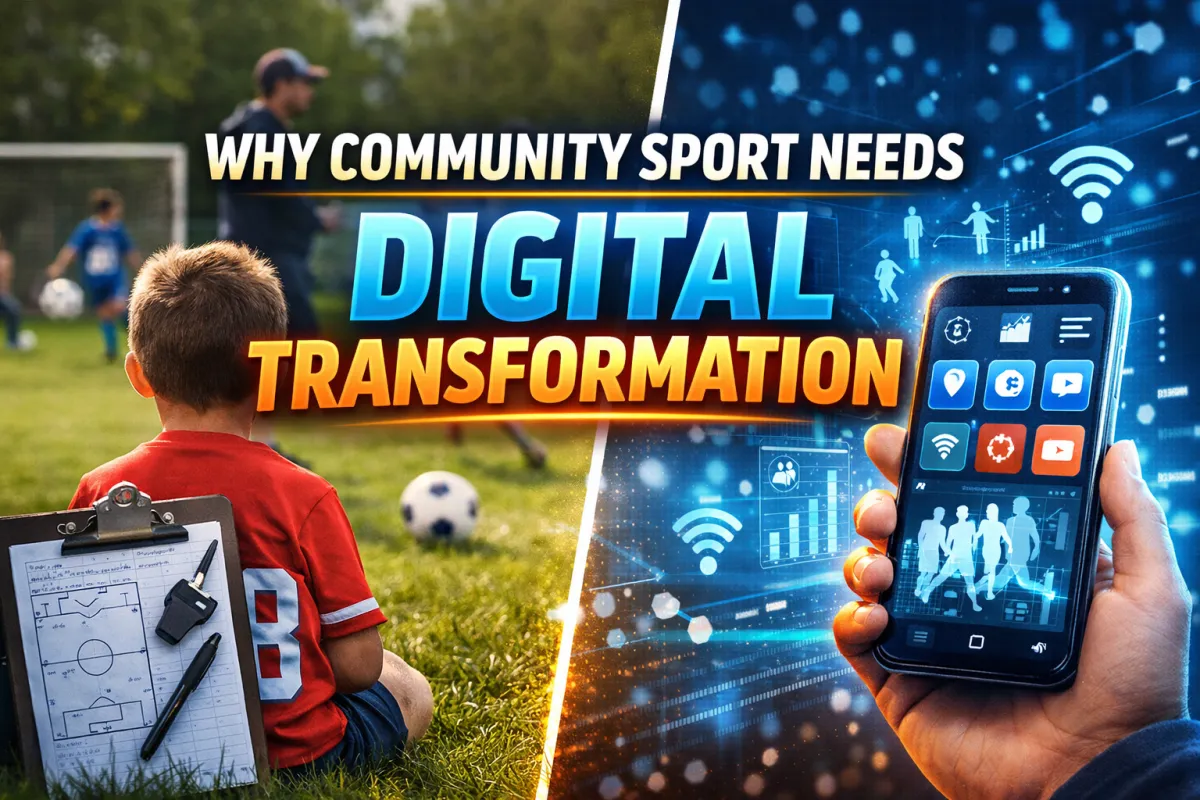
Key Takeaways:
Community sport is breaking under outdated, analog systems that no longer match modern family life.
Digital transformation is essential to reduce chaos, improve communication, and streamline club operations.
Volunteer burnout is driven by manual admin, and automation is the fastest way to relieve that pressure.
Clarity, Automation, Integration, and Insight are the four pillars that make clubs run smoothly.
Participation improves when parents get clean schedules, real-time updates, and a frictionless experience.
Digitally enabled clubs deliver safer, more consistent experiences for kids, improving retention and development.
Modernising community sport shifts clubs from constant firefighting to intentional design and long-term stability.
The Quiet Crisis on a Saturday Morning
On a cool Saturday morning, long before the first whistle blows, a junior soccer coach stands alone on the sideline staring at his phone with the same expression people reserve for tax forms and broken washing machines.
The team list is wrong. Three kids are missing.
Two are double-booked on the team sheet. One parent swears they uploaded the medical form “weeks ago,” but the system shows nothing.
And the canteen volunteer roster? Empty.
Meanwhile, parents gather behind him asking who they’re playing, which field they’re on, and why nobody knows the schedule.
This scene repeats itself every weekend in Australia, the UK, the US, and anywhere else community sport exists. Community sport — the cherished meeting ground where kids grow, families gather, and volunteers donate pieces of their lives — runs on infrastructure built for another era. Paper forms. Emails no one reads. Spreadsheets updated by one exhausted volunteer who guards the file like it’s nuclear launch codes.
For decades, community sport has absorbed this chaos with a kind of unspoken resilience. But the cracks are widening. Participation rates are dropping. Volunteers are burning out. Clubs are struggling to retain athletes. And kids — the actual reason the system exists — are left navigating an experience defined more by friction than joy.
This is the paradox: community sport is supposed to be the most accessible form of sport, yet its operational complexity has made it one of the hardest to manage.
Which raises the real question: What happens when the grassroots engine of an entire sporting ecosystem is still running on analog fuel in a digital world?
How Did Community Sport Fall Behind?
To understand the problem, you have to understand the history.
Community sport grew up in the age of clipboards, filing cabinets, and laminated maps. Systems were built around the assumption that clubs were small, participation was stable, and communication happened face-to-face. The club president knew every family. The registrar remembered every birthday. The coach handed out training times printed on paper kids shoved into school bags and never saw again.
That world is gone.
Family structures changed. Schedules became packed. Children now play multiple sports across multiple venues. Work hours blur into weekends. And communication — once centralised and simple — is now scattered across emails, texts, Facebook groups, WhatsApp threads, and half-forgotten app notifications.
The analog systems that served clubs for decades didn’t break overnight. They slowly became incompatible with modern expectations.
The gap between how community sport operates and how families live has widened every year.
What Is Digital Transformation in Community Sport?
Digital transformation sounds like a corporate buzzword, but in community sport it simply means this: replacing manual processes with digital systems that are faster, clearer, more reliable, and easier for everyone.
It means registrations that don’t require volunteers to retype information into three different spreadsheets. It means training schedules that update automatically when fields close.
It means injury tracking that actually protects young athletes instead of burying their history in a pile of forgotten PDFs. Digital transformation is not technology for technology’s sake. It is the strategic redesign of a community sports club’s operations around clarity, automation, and accessibility.
In other words: digital transformation is how community sport finally catches up to the way people actually live.
The Human Cost of Staying Analog
Before we talk about systems, we need to talk about people — because the people in community sport pay the price for inefficient structures.
Volunteers burn out first. They enter with enthusiasm and leave exhausted. They don’t quit because of the kids. They quit because community sport quietly assigns them a second full-time job without pay, boundaries, or support.
Coaches burn out next. They sign up to teach skills and build relationships. Instead, they spend their evenings chasing jersey numbers, field allocations, team lists, and last-minute parent messages.
Parents then disengage. Not because they don’t care, but because the process is chaotic. Every week feels like a scramble.
And the kids? They feel the friction indirectly. Sessions start late. Games are rescheduled poorly. Communication breaks down. Familiar faces disappear as volunteers churn.
The analog system strains every link in the chain.
The Digital Paradox: Community Sport Has the Most to Gain and the Least Adoption
Here is the most surprising insight: the level of impact digital transformation can create is highest in community sport, yet adoption is lowest.
Elite clubs operate with data platforms, scheduling tools, athlete-management systems, and automated workflows. But the grassroots system — the place where 95% of athletes spend 95% of their sporting life — runs like it’s 1998. This mismatch creates a downstream effect. Kids with potential slip through cracks. Injury risks go unnoticed. Participation drops when life gets busy. And clubs spend more time surviving than evolving.
Community sport doesn’t need fancy tools. It needs clear, simple, reliable systems that reduce friction, not add to it.
Why Digital Transformation Is Not Optional Anymore
There are five structural shifts forcing community sport into a turning point.
1. Modern families require real-time information.
Parents don’t check emails. Kids don’t track paper schedules. Families live on mobile devices where updates must be instant and clear.
Analog communication loses people.
2. Participation pathways are more complex.
Kids move across clubs, schools, regions, and representative programs. Without digital records, development becomes fragmented.
Digital systems preserve continuity.
3. Safety, compliance, and duty-of-care expectations have increased.
Medical notes. Injury reports. Concussion protocols. Working-with-children checks.
Paper cannot handle the legal complexity of modern sport.
4. Volunteers are disappearing.
Time-poor families cannot fill administrative gaps the way previous generations did.
Automation removes the burden.
5. Kids are competing with digital entertainment.
Sport must match the frictionless, intuitive experience kids get everywhere else.
Transformation protects participation.
Each of these forces pushes community sport to the same conclusion: If the administrative load stays the same, fewer people will carry it.
The Core Problem: Community Sport Still Treats Itself as a Hobby
Here is the truth: community sport is not a hobby. It is one of society’s largest distributed organisations. With tens of thousands of teams, hundreds of thousands of volunteers, and millions of participants, it operates at a scale that would make most mid-sized companies implode.
And yet, it uses systems smaller than the ones used by local coffee shops. In business terms, the problem is simple: community sport has the operational demands of an enterprise with the resources of a small family business. This mismatch makes digital transformation not a luxury, but a survival strategy.
How Does Digital Transformation Improve Participation?
Parents don’t sign their kids up for disorganised experiences. They want clarity, safety, and communication. Digital transformation removes the barriers that prevent kids from joining and staying. When scheduling is clear, participation rises. When communication is reliable, commitment increases. When clubs are organised, families stay long-term.
Digital transformation protects the very outcome community sport exists for: kids playing sport.
How Digital Systems Build Stronger Clubs
Digital transformation is not about buying an app. It’s about building capacity. A club with digital systems can:
- Automate reminders
- Streamline registration
- Manage waitlists
- Track attendance
- Coordinate volunteers
- Record development data
These aren’t administrative tasks. They are strategic levers that strengthen the club’s foundation. An organised club attracts more families. A well-run club keeps more volunteers. A data-driven club develops more athletes. A connected club becomes a community anchor.
Digital transformation is, at its core, community empowerment.
The Framework: The Four Pillars of Digital Transformation in Community Sport
When you strip away the noise, digital transformation in community sport rests on four pillars: clarity, automation, integration, and insight.
Pillar 1: Clarity
Clarity removes confusion. It eliminates the endless back-and-forth messages and gives families what they need instantly.
In community sport, clarity means: schedules accessible in one place, communication delivered through one channel, information presented in simple language. Clarity reduces stress. And stress is the silent killer of participation.
Pillar 2: Automation
Automation removes manual labour. It replaces repetitive tasks with predictable workflows that run without human input.
In community sport, automation might include: Registration flows, volunteer rostering, payment reminders, injury follow-ups, training cancellations. Automation returns hours — hours that volunteers can redirect to coaching, culture, and connection.
Pillar 3: Integration
Integration means all systems talk to each other. Not ten different apps. One ecosystem.
In community sport, integration threads together: Player records, medical notes, training attendance, payments, communication, schedules. When systems connect, clubs remove duplication. And duplication is the hidden tax on every volunteer.
Pillar 4: Insight
Insight turns data into better decisions.
In community sport, insight can answer real questions:
Which kids are at injury risk?
Which programs are growing?
Where are volunteers burning out?
Which teams need more support?
What improvements actually matter?
Insight elevates clubs from reactive to proactive.
The Cultural Shift: From Surviving to Designing
Digital transformation does more than fix problems. It changes culture. It shifts clubs from firefighting to planning, from holding things together to building things that last. Most importantly, it puts community sport back in alignment with its purpose: creating environments where kids thrive. When a club operates smoothly, people feel it. Sessions start on time. Coaches are prepared. Volunteers stay. Parents trust the process. Kids feel the consistency and stability that development requires.
Digital transformation doesn’t just improve the user experience. It strengthens the social fabric that holds community sport together.
Why This Matters for the Future
Community sport sits at the intersection of physical health, mental health, identity formation, and social connection. It teaches teamwork, resilience, and the joy of movement. It anchors families. It builds culture. It reduces screen time. It creates belonging.
But if community sport remains analog while the world moves digital, it will continue to lose relevance, participants, and influence.
The only way forward is to build modern infrastructure for a timeless mission. The mission is not changing. The tools must.
What Happens When Community Sport Does Transform?
Let’s imagine a Saturday morning ten years from now. Parents arrive and know exactly where to go. Coaches open training plans from their phones. Volunteers receive automated reminders. Kids check into sessions digitally. Medical notes update instantly.
Clubs run with clarity, not chaos.
The experience feels effortless. Participation rises. Retention stabilises. Coaches focus on coaching. Families feel supported, not burdened. Kids leave sessions smiling because the system now works for them, not against them.
This is not wishful thinking.
This is what happens when community sport stops surviving and starts designing.
The Final Argument: Community Sport Deserves Better Systems
Think of community sport as the most important startup in your town — one with no budget, no paid staff, and no technology stack. Yet it influences the physical, emotional, and social development of thousands of kids every year. If you saw a startup with that level of impact using handwritten forms and scattered spreadsheets, you wouldn’t call it charming. You’d call it risky.
The world has changed. Families have changed. Expectations have changed.
And community sport deserves systems that match its importance. Digital transformation isn’t about software.
It’s about dignity.
It’s about giving volunteers their evenings back.
It’s about giving coaches the tools to teach.
It’s about giving families clarity.
It’s about giving kids a safe, well-run environment where they can grow.
Community sport holds the future — and it’s time the infrastructure finally supports the mission.
FAQ
1. Why does community sport need digital transformation?
Community sport needs digital transformation because analog systems—paper forms, spreadsheets, scattered communication—no longer match how modern families live. These outdated processes create chaos, reduce participation, burn out volunteers, fragment athlete development, and make operations inefficient. Digital transformation allows clubs to run with clarity, automation, and stability.
2. How did community sport fall behind in adopting digital systems?
Community sport fell behind because its systems were built in an era of clipboards, face-to-face communication, and small, predictable clubs. As family schedules changed and communication moved to digital channels, the old infrastructure became incompatible with modern expectations, creating a widening gap between operations and participant needs.
3. What is digital transformation in community sport?
Digital transformation in community sport is the shift from manual, fragmented processes to integrated digital systems that provide clarity, automation, and accessibility. It includes automated registrations, real-time scheduling, digital injury tracking, unified communication, and streamlined operational workflows designed to match how families actually live today.
4. How does digital transformation improve participation in community sport?
Digital transformation improves participation by reducing friction. When schedules are clear, communication is reliable, and club operations run smoothly, more families join and stay. Clean systems increase commitment, reduce confusion, and remove the barriers that traditionally cause children to drop out of community sport.
5. Why are volunteers burning out in community sport?
Volunteers burn out because analog systems force them to take on excessive administrative tasks—manually updating spreadsheets, chasing information, coordinating schedules, and handling communication. Digital automation removes this invisible workload, giving volunteers their time and energy back while improving the overall club experience.
6. What are the Four Pillars of digital transformation in community sport?
The Four Pillars of digital transformation are Clarity, Automation, Integration, and Insight. Clarity reduces confusion through unified communication. Automation eliminates manual labour. Integration connects all systems into one ecosystem. Insight uses data to guide decisions, prevent issues, and strengthen programs.
7. What happens when a community sports club fully modernises its systems?
A digitally transformed club runs with clarity, not chaos: parents know where to go, coaches arrive prepared, volunteers receive automated reminders, kids check in digitally, and medical notes update instantly. Participation rises, retention improves, stress drops, and the entire community feels supported rather than burdened.
Luke Wilson is the founder of Switch Performance and an authority on the rehabilitation of sporting injuries that derail promising careers and lead athletes to be labelled "injury prone".


10th
Experience
Ready To Bring Elite Expertise To Your Club?
Give your players, parents & coaches the support they deserve.
We bring you the latest exercise programs with live Q&A, monthly coaching webinars, data profiling and direct access to experts in sports performance. Switch is the first digital platform to bring elite-level expertise down to the grassroots-where it belongs.



Pages


© 2025 Perth, Australia - All Rights Reserved.