

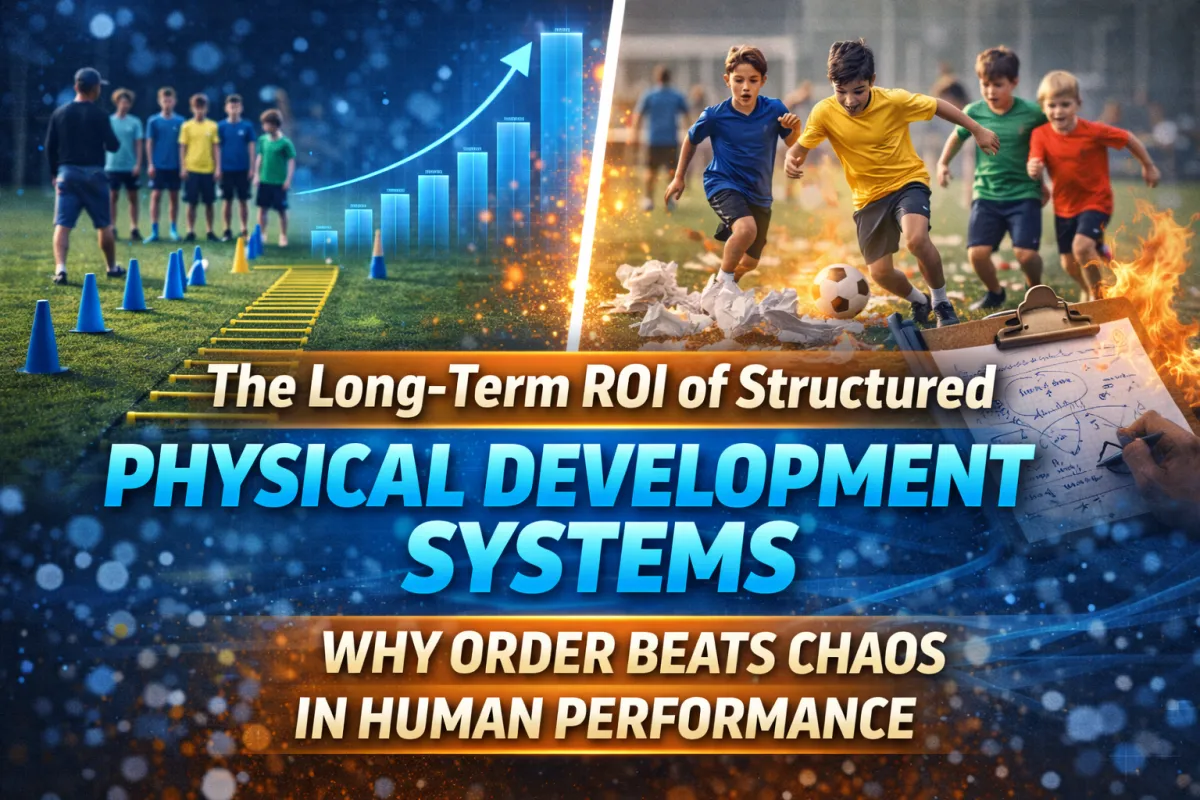
Key Takeaways:
Structured physical development systems create predictable, repeatable progress by replacing random training with long-term planning and progression.
Strength and mobility deliver the highest long-term ROI because they underpin every major athletic quality, including speed, power, and durability.
Consistent, progressive workload management reduces injury risk by avoiding sudden spikes in training stress.
Structure compounds physical development over months and years, producing stability, resilience, and sustained performance.
Unstructured training feels productive but leads to inconsistent results, plateaus, and preventable injuries.
Athletes who follow systems gain psychological ROI—discipline, confidence, and long-term thinking—that supports sustained improvement.
The deepest ROI of structured systems is athletic longevity, consistent availability, and increased opportunity across seasons and career stages.
The Small Story That Exposes a Big Truth
A few years ago, a youth baseball coach told me about an athlete named Levi. At 13, he threw hard enough to get noticed, but everything else about his training looked like a messy garage. No plan. No progression. No structure. Just scattered drills from YouTube and whatever his team happened to run that week.
His season looked like a roller coaster. Great one month. Hurt the next. Big gains. Big drops. No predictability. No compounding.
Then came the twist.
A new coach shifted Levi to a structured physical development system. Suddenly, every week had a purpose. Strength, mobility, speed, rotational power, tissue load — all tracked, all programmed, all progressing.
In one year, Levi wasn’t just better. He was consistent. His performance became stable. Durable. Predictable. He didn’t burn out. He didn’t stall. He didn’t get trapped in the early talent illusion that fools so many families.
The paradox is simple: chaotic training feels “free,” but structured training creates freedom.
What Is a Structured Physical Development System?
A structured physical development system is a long-term, goal-driven training curriculum that organizes strength, mobility, speed, power, conditioning, and recovery into progressive blocks. It removes randomness and replaces it with repeatable patterns that drive predictable outcomes.
Think of it as the difference between “going to the gym” and “training.”
One is motion. The other is progress.
- A structured physical development system includes:
- A defined starting point (baseline assessment)
- A clear long-term progression model
- A weekly and monthly load strategy
- A feedback loop to adjust training intelligently
- A way to measure physical qualities over time
- A plan that prevents athletes from training harder than their bodies can tolerate
- Without this system, athletes fall into the trap of doing more instead of doing smarter. And “more” is the biggest red herring in youth sports.
Why Long-Term ROI Matters More Than Short-Term Gains
Parents, coaches, and even athletes often make decisions based on next week’s game instead of next year’s development. But physical qualities like strength, mobility, and power compound like financial investments. When you build a base and stack improvements over years, the return multiplies. This is why athletes who train with structure often look “suddenly” elite earlier than their peers — not because they found a hack, but because they followed a system long enough for the compounding effect to take over.
The ROI isn’t just performance. It’s longevity. It’s resilience. It’s efficiency. It’s consistency. It’s reduced injury downtime and increased opportunity.
Most importantly, it’s the ability to control your athletic trajectory instead of hoping talent takes you far enough.
Why Predictable Systems Beat Heroic Effort
The strange thing is: the athletes who work the hardest often don’t get the best results. They grind, they compete, they hustle, but they burn out or break down.
Why?
Because effort without structure is like sprinting in sand. It feels exhausting, but you don’t go far. Gladwell might call this the tyranny of uncontrolled variables. Humans love stories of underdogs who “outwork” everyone. But we rarely talk about the thousands of talented athletes who disappeared because they trained without a system. Framed it more bluntly:
If your effort is random, your results will be random.
Structured development removes that randomness. It creates a straight line where everyone else is zig-zagging.
How Does Structured Physical Development Improve Long-Term Performance?
To understand the long-term ROI, you first need to understand how physical qualities interact over time.
Strength supports power.
Mobility supports efficiency.
Speed requires strength and technique.
Recovery dictates how much load you can tolerate.
Every quality is interconnected. When you improve each one in the right order, the results compound.
Imagine a spiral staircase. Each rotation lifts you higher, but only if you keep climbing. Structured systems are the architecture. They make sure the staircase exists. Without structure, athletes jump from step to step and fall through gaps.
That is the ROI: the ability to keep climbing.
Systems ROI = Fewer Mistakes + Fewer Injuries + Fewer Gaps
Most business gains come from avoiding losses. Training is the same.
A structured system creates ROI in three ways:
Fewer mistakes: Random training produces plateaus. Structured training minimizes wasted effort.
Fewer injuries: When load progression is controlled, tissue stress becomes predictable instead of chaotic.
Fewer gaps: Most athletes have huge “silent weaknesses” they don’t even realize are holding them back. Systems expose them, then eliminate them.
You get ROI not by being superhuman, but by removing the things that sabotage your development.
The Hidden Cost of Chaotic Training Programs
Most athletes (and parents) don’t realize how expensive unstructured training is. Not in money, but in opportunity cost.
Chaotic training costs you: Seasons lost to injury, Physical qualities that never mature, Repetitive workouts that never adapt, Months stuck in plateaus, Skills built on weak foundations, Missed windows of development, Wasted time and emotional energy.
The biggest cost? Inconsistency.
Talent can shine in short bursts. But sustained performance — the kind that gets athletes selected, recruited, and retained — comes from consistency.
Structured systems turn consistency into a competitive advantage.
Why “Training Alone” Is Not a System
Many athletes believe they’re following a system because they have a gym membership, a program on their phone, or a routine they repeat.
But repeating a routine doesn’t make it a system.
A system is defined by adaptation. It changes as you change. It grows as you grow. It detects issues early and responds with precision.
A static routine is the opposite of that. It’s like following the same map even after the roads have changed.
How Structured Systems Reduce Injury Risk Over Time
There is a clear and intuitive reason structured training reduces injury risk: progressive loading and planned recovery improve tissue tolerance.
You don’t need studies to understand this — it’s basic physiology. Muscles, tendons, and joints adapt to consistent stress. They break down under chaotic spikes. A structured physical development system avoids sudden jumps in workload by:
- Tracking volume and intensity
- Progressing load gradually
- Scheduling deload weeks
- Monitoring recovery
- Adjusting for fatigue, travel, competition, or stress
- Injuries don’t come from training. They come from poor planning.
When planning becomes systematic, injuries decline. That is long-term ROI in its purest form.
Why Strength and Mobility Are the Highest-ROI Components
Strength and mobility are the foundation of every athletic movement. They influence power output, speed mechanics, joint efficiency, and injury resilience. Even a small increase in strength changes the entire performance landscape. It gives athletes more margin. More stability. More control. More force production.
Mobility is equally powerful. It improves movement economy, allows force to transfer efficiently, and prevents compensations.
Together, strength and mobility act like compound interest. Each quality supports the growth of the others.
If you want the highest long-term ROI, invest in the qualities that influence everything else.
The Business Analogy: Why Systems Scale and Randomness Fails
If you ever watch high-performing companies, you’ll notice a pattern: they obsess over systems.
They don’t rely on luck. They don’t rely on motivation. They don’t rely on heroic employees.
They rely on structure.
Athletic development works the same way. A structured system:
- Scales training from month to month
- Produces predictable outcomes
- Removes decision fatigue
- Eliminates inconsistency
- Enables long-term planning
- Athletes who rely on motivation burn out. Athletes who rely on systems keep improving even on low-motivation days.
This is the same logic behind business automation: remove variability, increase throughput.
What Is the ROI Timeline for Structured Physical Development?
The timeline depends on consistency, age, training history, and biological development. But the pattern is remarkably stable:
0–3 months
Athletes see improvements in technique, stability, and confidence.
3–9 months
Strength, mobility, and speed adaptations become measurable.
9–18 months
Power output and sport-specific qualities begin compounding.
18–36 months
The athlete becomes structurally different — stronger, more resilient, more efficient.
This timeline mirrors long-term skill acquisition: early gains are big, but the transformational ROI takes multiple cycles.
If you want the long-term ROI, you must think long-term.
How Structured Systems Build Psychological ROI
The ROI isn’t just physical. It’s psychological. Athletes who train with structure develop:
- Discipline
- Confidence under pressure
- Trust in the process
- Emotional regulation
- Identity as a developing athlete
Some might call this the “software upgrade, ” other's call it “replacing excuses with data.”
Either way, athletes gain a mental framework that supports growth far beyond the gym.
Case Study Pattern: Why So Many Elite Athletes Follow Systems
This isn’t about any one athlete or team. It’s about the recurring pattern you see across elite development pathways.
Not one of them trains randomly.
They follow systems: Strength plans. Speed plans. Mobility plans. Load plans. Recovery plans.
You don’t need to cite statistics to see the pattern: every high-performing environment relies on structure.
Because structure is predictable. And predictable is scalable.
Why Unstructured Training Feels Good but Fails Long-Term
There is a psychological trap all humans fall into: we like what feels productive more than what is productive.
Random training feels productive because it’s varied, intense, or exciting. But intensity without progression is a false signal.
Structured training often feels slower at first. More methodical. Less chaotic. Less adrenaline.
But that’s the point.
It builds athletes who can perform not just today, but next month, next year, and beyond.
The Final ROI: Identity, Opportunity, and Longevity
The deepest ROI isn’t in numbers. It’s in identity. A structured physical development system builds athletes who:
- Take responsibility
- Understand their bodies
- Track their progress
- Think long-term
- Train intelligently
- Avoid burnout
- Stay healthy
- Improve consistently
This identity creates opportunity. Coaches trust consistent athletes. Scouts value durability. Teams invest in players who stay available.
Longevity becomes a competitive advantage.
That is the long-term ROI.
Conclusion: The Quiet Power of Structured Physical Development
If Malcolm Gladwell (Author of the famous book: Outliers) were to summarize this entire concept, he’d say structured systems succeed because humans thrive under patterns. Chaos is thrilling but unsustainable. Structure is boring but transformational.
If Alex Hormozi (Author of $100 Million Offers) were to summarize it, he’d say the athletes who win are the ones who make fewer mistakes, avoid stupid injuries, and accumulate more productive training weeks than everyone else.
The truth is this:
- Structured physical development is the closest thing sport has to a guarantee.
- It doesn’t promise fame. It doesn’t promise stardom. But it promises progress — steady, compounding, durable progress — for anyone willing to follow the system long enough.
And that is the greatest ROI an athlete can ever receive.
FAQ
1. What is a structured physical development system in sports training?
A structured physical development system is a long-term, goal-driven training framework that organizes strength, mobility, speed, power, conditioning, and recovery into a progressive plan. Instead of random workouts, it uses baseline assessment, clear progression models, planned weekly and monthly training loads, and feedback loops to adjust training over time. The aim is to create predictable, repeatable improvements in performance and resilience, rather than relying on motivation, guesswork, or scattered drills.
2. How does a structured physical development system improve long-term athletic performance ROI?
A structured physical development system improves long-term ROI by allowing physical qualities to compound over months and years, much like a financial investment. By sequencing and progressing strength, mobility, speed, power, and recovery in a logical order, it reduces wasted effort and builds a stable foundation for performance. Athletes move from short-term spikes and plateaus to consistent, incremental gains, which leads to better performance, more reliability, more opportunity, and a higher overall return on the time and money invested in training.
3. Why is a structured physical development system better than random or unstructured training?
Random or unstructured training often feels productive but delivers unpredictable, unstable results, along with a higher risk of burnout and injury. There is no clear progression, no controlled workload, and no systematic way to address weaknesses. A structured physical development system, in contrast, reduces variability, manages training load, and ensures that each training block builds on the last. This leads to fewer mistakes, fewer performance gaps, fewer preventable injuries, and much more consistent progress over the long term.
4. How does a structured physical development system reduce injury risk over time?
A structured physical development system reduces injury risk by controlling and progressing workload, rather than allowing sudden spikes in training stress. It tracks volume and intensity, plans gradual load progression, schedules deload or lighter weeks, and incorporates recovery and monitoring into the plan. This approach increases tissue tolerance in muscles, tendons, and joints, making them more resilient to sport demands. Over time, this systematic load management leads to fewer breakdowns and less time lost to avoidable injuries.
5. Which athletes and stakeholders benefit most from structured physical development systems?
Structured physical development systems benefit a wide range of stakeholders, including youth athletes, high-performance athletes, parents, coaches, and sport organizations. Youth athletes gain a safer, more predictable path for developing strength, mobility, speed, and power without being overworked or rushed. Parents get more confidence and clarity about what their child is doing and why. Coaches and organizations gain more durable, consistent players who can train and compete more reliably across a season and over multiple years.
6. What are the highest-ROI components inside a structured physical development system?
Within a structured physical development system, the highest-ROI components are strength and mobility training, supported by intelligent workload management and recovery. Strength improves force production, stability, and control, while mobility improves movement efficiency and force transfer across joints. Together, they influence almost every other quality — including speed, power, and durability. Because they underpin so many aspects of performance, consistent investment in strength and mobility yields powerful long-term returns.
7. What is the typical timeline for seeing long-term ROI from a structured physical development system?
The article describes a long-term ROI pattern that unfolds in stages. In the first 0–3 months, athletes typically notice better technique, stability, and confidence. Between 3–9 months, measurable changes in strength, mobility, and speed become apparent. Over 9–18 months, power and sport-specific performance start to compound. By 18–36 months, the athlete is often structurally different — stronger, more resilient, and more efficient. The key takeaway is that the full ROI of a structured physical development system emerges over multiple training cycles, not just a few weeks.
Luke Wilson is the founder of Switch Performance and an authority on the rehabilitation of sporting injuries that derail promising careers and lead athletes to be labelled "injury prone".


10th
Experience
Ready To Bring Elite Expertise To Your Club?
Give your players, parents & coaches the support they deserve.
We bring you the latest exercise programs with live Q&A, monthly coaching webinars, data profiling and direct access to experts in sports performance. Switch is the first digital platform to bring elite-level expertise down to the grassroots-where it belongs.



Pages


© 2025 Perth, Australia - All Rights Reserved.