

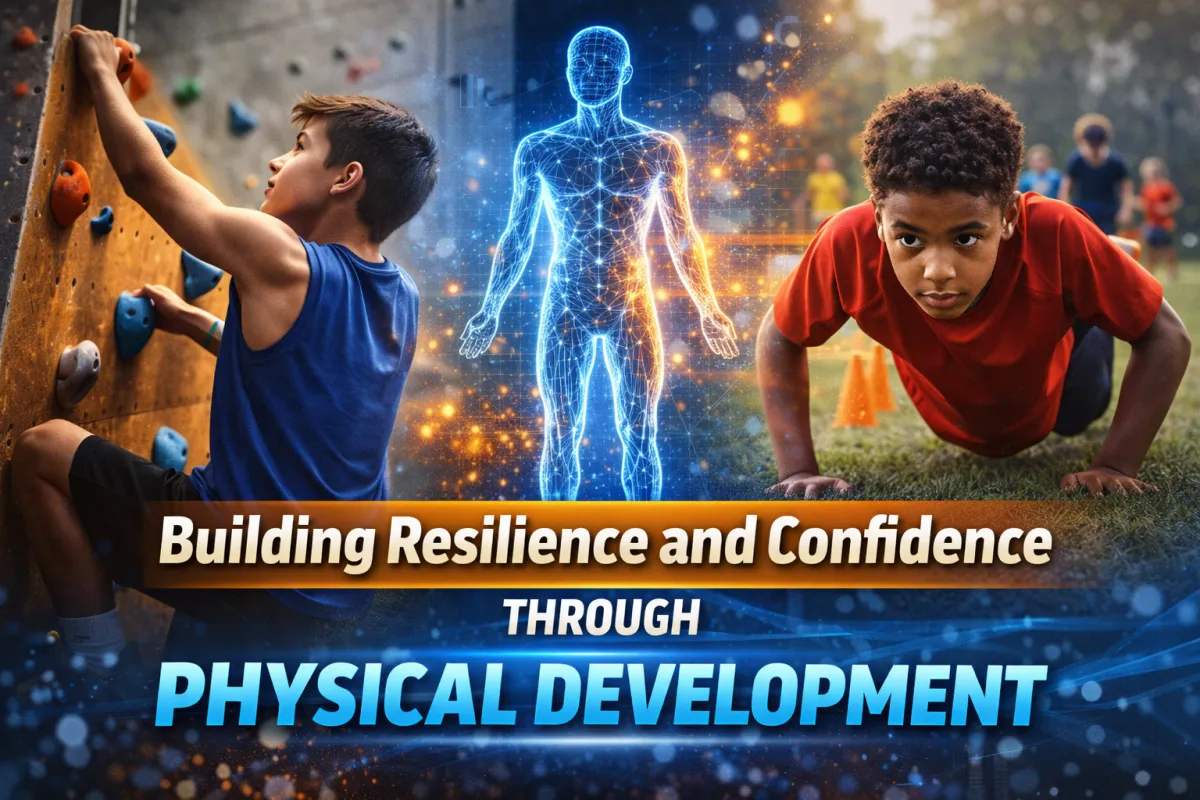
Key Takeaways:
Physical development builds resilience by exposing young athletes to controlled, progressive difficulty.
Strength creates competence, and competence is the foundation of real, evidence-based confidence.
Emotional regulation improves through physical training because the nervous system adapts to stress.
Physical development shapes identity by reinforcing mastery, consistency, and observable improvement.
Struggle is essential—lasting confidence cannot form without overcoming challenge.
Structured training gives teenagers predictability, agency, and a stable developmental anchor.
Strength reduces social insecurity and improves social confidence by increasing perceived capability.
Physical goals provide the clearest, most achievable first goals for developing minds.
Training environments make failure safe, turning mistakes into feedback instead of identity threats.
Small, trackable physical improvements create rapid confidence gains through early wins.
Resilience grows best where the challenge is high but emotional support is even higher.
Physical development works for every personality type because the body adapts regardless of mindset.
The principles of physical improvement become a lifelong mental model for growth in all areas.
Self-doubt is replaced by self-data—proof of capability that builds unshakeable confidence.
Why Physical Development Shapes the Way We See Ourselves
On a warm afternoon in suburban Sydney, a twelve-year-old baseball player stood on the edge of a dusty infield holding a resistance band like it was a ticket to somewhere he wasn’t sure he could go. His coach had told him he needed to get stronger. His dad had nodded with that careful blend of hope and uncertainty. And he, like so many young athletes, wasn’t just wondering whether he could throw harder; he was wondering whether he could become the kind of person who does hard things.
That moment happens everywhere — baseball fields, basketball courts, cramped school gyms where floorboards echo with more self-doubt than sneakers. It’s the universal crossroads where physical development collides with identity formation. At first glance, it looks like sport. But step back even a little, and it becomes something deeper: a training ground for resilience, confidence, and self-belief.
This is the paradox most adults miss.
Kids don’t become confident and resilient after they become strong. They become strong because resilience and confidence were built along the way. The physical changes are easy to see. The psychological ones, the ones that carry through life, are harder to notice until much later.
The Simple Framework: Strength Creates Competence, Competence Creates Confidence
If you strip away the noise — the drills, the reps, the “grind” culture, even the sport-specific details — physical development operates on a simple, reliable loop: strength creates competence; competence creates confidence; confidence fuels resilience.
You don’t need a psychology degree to recognise this. You’ve felt it. Every time your body does something today that it couldn’t do last month, you experience a small, honest win. And that win rewires something internal — not in the motivational-poster sense, but in the neural and behavioural sense.
People often ask why physically trained kids show better emotional control, greater social confidence, and improved academic focus.
The answer isn’t magic.
It’s that physical training is the most tangible, measurable, and immediate form of self-improvement available to a young mind. When you can feel progress in your muscles, joints, and nervous system, it becomes impossible to deny that improvement is possible.
Physical development is the laboratory of self-belief.
What Is “Resilience” Really? A Skill, Not a Personality Trait
Pop culture treats resilience like a personality trait — something you either have or don’t. But modern behavioural science makes it clear: resilience is a trainable skill, built through repeated exposure to controlled difficulty, paired with positive adaptation.
In simpler terms, you get resilient by doing hard things that you survive, rethink, and eventually master.
Resistance training, sprinting mechanics, physical conditioning — these are ideal resilience-building environments because:
- Difficulty is progressive and predictable.
- Feedback is immediate.
- Progress is measurable.
- Setbacks are temporary and normal.
Improvement is inevitable when work is consistent.
These features create the perfect ecosystem for shaping a resilient mind. Every rep is a micro-dose of adversity with a built-in win condition.
This is why physical development matters far beyond sport. It trains the nervous system to expect challenge, adapt to it, and move forward.
Why Physical Strength Builds Psychological Safety
A counterintuitive point: the physically stronger an athlete becomes, the safer the world seems. Not because danger disappears, but because capability grows. Think of it this way — confidence isn’t about believing nothing will go wrong; it’s about believing you can handle what goes wrong.
Strength is the earliest and most primitive signal of capability.
When a young athlete learns they can generate force, control movement, recover from fatigue, and push past discomfort safely, the brain updates its internal estimation of risk. It begins to trust the body. This trust isn’t just physical. It spills into school, friendships, and daily problem-solving.
A kid who has pushed through the last thirty seconds of a tough sled push suddenly has more evidence that they can:
- Sit through an exam.
- Navigate a social conflict.
- Handle criticism.
- Try something new.
- Physical development creates psychological margin. And that margin is the birthplace of real confidence.
How Physical Development Shapes Identity and Self-Concept
Identity doesn't form because someone tells you who you are. It forms when repeated behaviours confirm who you're becoming.
Physical training reinforces identity through:
- Repetition
- Mastery
- Observable improvement
- Social recognition
- Long-term consistency
This makes training uniquely powerful for shaping identity during adolescence.
When a 13-year-old says, “I’m the kind of person who trains,” they’re not describing a hobby — they’re describing a self-concept. From that moment, discipline becomes part of their character, not something they argue with themselves about.
That’s why physical development is foundational. It gives kids something achievement-based to anchor their identity to — not talent, not luck, not external validation, but behaviour.
Why Struggle Is the Only Way to Build Real Confidence
Confidence is often misunderstood as self-belief. But real confidence is evidence-based. It’s built through repeated exposure to challenge paired with successful action.
Here’s the truth most people don’t want to hear: you cannot build confidence without struggle. The very process that increases muscular strength — progressive overload — is the same process that hardens psychological resilience. Both require voluntary exposure to discomfort.
This is why “easy wins” don’t produce lasting confidence. Only difficulty produces adaptations worth keeping.
The struggle is the system.
How Does Physical Development Improve Emotional Regulation?
Emotional regulation improves because physical training requires it. When heart rate spikes, breathing becomes erratic, and muscles fatigue, the athlete must learn to calm their system to maintain performance. Over time, the nervous system adapts.
This is called “stress inoculation.”
Through repeated experiences of controlled physical stress, the athlete builds the biological equivalent of emotional armour. Their threshold for frustration rises. Their ability to stay calm under pressure expands. And their sense of self-control becomes more stable.
These emotional regulation gains happen automatically. No sports psychology workbook is required.
The body teaches the mind.
The Confidence–Resilience Loop: Why One Fuels the Other
Confidence without resilience collapses under pressure. Resilience without confidence becomes frustration. Physical development solves both sides of the equation. The loop looks like this:
- You set a physical goal.
- You struggle.
- You adapt.
- You improve.
- You succeed.
- You update your self-belief.
- You repeat.
Each pass through the loop strengthens the internal model of “I can.” The athlete becomes biologically conditioned to see challenge not as threat but as opportunity.
This is how physical training becomes psychological transformation.
Why Teenagers Benefit the Most from Physical Development
Adolescent athletes exist at the intersection of:
- explosive neural development
- peak sensitivity to social comparison
- unstable self-concept
- emotional volatility
- rapid physical change
This makes the teenage years the highest-leverage window for pairing physical development with psychological growth.
A structured training environment introduces predictability into a developmental window full of unpredictability.
When everything else feels chaotic, the gym becomes an anchor. Teens learn:
- how to plan
- how to execute
- how to fail safely
- how to self-correct
- how to measure improvement
The teenage brain thrives on these patterns. They reduce uncertainty and increase agency — two psychological ingredients essential for long-term resilience.
Strength Training as a Tool for Social Confidence
This often goes unspoken, but it’s obvious when you work with youth athletes: physical strength changes social behaviour.
Not because stronger kids dominate others. But because strength reduces social insecurity. A kid who believes they are capable physically is far less likely to interpret social situations as personal threats. They take up more psychological space. They speak with more clarity. They participate more fully.
Strength gives kids permission to be present.
This is one of the great intangible gifts of physical development, and it often shows up long before any measurable athletic improvement.
Why Physical Goals Are the Best First Goals for Developing Minds
Academic goals are abstract. Social goals depend on other people. Emotional goals are hard to measure.
But physical goals? Simple. Concrete. Immediate.
- Do five push-ups today.
- Do six next week.
Feel the difference.
Physical development provides a learning model that young people can understand and execute. The clarity of physical goals becomes a template for pursuing non-physical goals later.
The structure becomes the transferable skill.
The Hidden Advantage: Physical Development Makes Failure Safe
Failure inside a physical training environment is different from failure in school or social life. Miss a lift? Try again. Lose form on a sprint? Rest and repeat. No shame, no punishment, no permanent stain.
Physical training turns failure into feedback.
This normalises error in a way that rewires a young athlete’s relationship with setbacks. They begin to see mistakes not as evidence they are “not good enough” but as data.
That shift — from identity threat to information source — is the heart of resilience.
What’s the Fastest Way to Build Confidence Through Physical Training?
The fastest way to build confidence is to create a clear, achievable plan that produces visible progress quickly. Not crushing sessions.
Not max effort workouts. Not random “hard work.” But small, measurable, trackable improvements.
This is what creates the cascade of early wins that reinforce the identity loop: “I am someone who improves.” From a coaching perspective, this means:
- Set clear progression rules.
- Use objective metrics.
- Provide immediate feedback.
- Make wins visible.
- Celebrate consistency, not intensity.
- Confidence comes from competence, and competence comes from clarity.
How Parents and Coaches Can Build Resilience Without Burnout
Burnout is not caused by training load alone. Burnout comes from a mismatch between challenge and recovery, between expectation and support.
To build resilience without breaking the athlete:
- Keep difficulty progressive, not random.
- Provide emotional support equal to physical demand.
- Teach athletes to reflect, not ruminate.
- Reinforce effort over outcome.
- Celebrate long-term consistency more than short-term results.
- Resilience grows in environments where challenge is high but support is higher.
Why Physical Development Works for Every Personality Type
Some kids are anxious. Some are bold. Some are introverted, analytical, dramatic, cautious, excitable, or stoic. Physical development helps them all, because it doesn’t depend on personality. It depends on physiology.
The body adapts whether the mind believes it will or not. And once the adaptation happens, the mind recalibrates around it.
Confidence, then, becomes less about personality and more about evidence.
Physical Development as a Lifelong Mental Model
When young people learn the laws of physical improvement, they accidentally learn the laws of improvement in everything else:
- You get better with repetition.
- You adapt to stress.
- You can change yourself over time.
- Failure is part of the process.
- Progress compounds.
This becomes a worldview. Athletes who internalize this model carry it into:
- academics
- careers
- relationships
p- ersonal challenges
- long-term health
Physical development becomes the root system that supports the entire tree of adult life.
The Real Reason Physical Development Builds Unshakeable Confidence
The real reason is simple: physical development gives young athletes undeniable proof that they can grow. Not hope. Not belief. Evidence. You can’t argue with your own progress. You can’t deny strength you can feel. You can’t rationalise away a sprint time you’ve beaten or a band tension you’ve mastered.
Physical development replaces self-doubt with self-data.
That’s what creates unshakeable confidence — a body of evidence that you are capable, adaptable, and resilient.
Final Thought: The Body Is the First Classroom of the Mind
At the end of that dusty infield session, the twelve-year-old finished his set and looked at his coach the way kids do when they’ve surprised themselves. Not a grin. Not a celebration. Just a quiet, internal recognition: “I did that.” Physical development begins with the body, but it ends with the mind. And somewhere in between — in the reps, the sweat, the awkward early attempts and the surprising breakthroughs — a young person discovers who they are capable of becoming.
That discovery is the foundation of resilience. That discovery is the engine of confidence.
And that discovery is available to anyone willing to take the first step.
FAQ
1. What is physical development and how does it build resilience in youth athletes?
Physical development is the process of increasing strength, coordination, mobility, and physical capability through structured training. It builds resilience by exposing young athletes to controlled difficulty, progressive overload, and consistent feedback. Each physical challenge becomes a “micro-dose of adversity” that strengthens the nervous system and teaches the athlete to adapt, recover, and move forward.
2. How does strength training improve confidence in adolescents?
Strength training improves confidence by creating clear, measurable, evidence-based progress. When young athletes feel their body do something it couldn’t do last month, the brain updates its internal model of capability. This competence—the “I can” signal—directly increases confidence and becomes a psychological loop: strength creates competence, competence creates confidence, and confidence fuels resilience.
3. Why is physical development important for emotional regulation?
Physical development improves emotional regulation because intense physical training requires athletes to control breathing, manage fatigue, and remain calm under stress. Over time, the nervous system adapts through “stress inoculation,” building emotional stability, reducing frustration, and strengthening self-control in high-pressure situations—both in sport and daily life.
4. What makes resilience a trainable skill rather than a personality trait?
Resilience is trainable because it develops through repeated exposure to challenge paired with positive adaptation. Activities like resistance training, sprinting mechanics, and conditioning create predictable difficulty, immediate feedback, and measurable improvement. These repeated experiences teach athletes to survive, rethink, and eventually master hardship.
5. How does physical development shape a young athlete’s identity and self-concept?
Physical development shapes identity through repetition, mastery, observable improvement, social recognition, and long-term consistency. When adolescents repeatedly succeed in training, they begin to see themselves as “someone who trains” — building a durable identity anchored in behaviour rather than talent or external validation.
6. Why is physical training especially powerful during adolescence?
Adolescence is the highest-leverage window for physical development because teenagers experience rapid neural growth, heightened social comparison, unstable self-concept, emotional volatility, and major physical change. A structured training environment adds predictability, teaches planning and self-correction, and creates agency during an otherwise chaotic stage of life.
7. What is the fastest way for parents or coaches to build confidence in young athletes?
The fastest way to build confidence is through small, measurable, trackable physical improvements—not overly intense or complex sessions. Clear progression rules, objective metrics, immediate feedback, and visible wins reinforce the identity loop (“I am improving”), which accelerates confidence development. Consistency matters more than intensity.
Luke Wilson is the founder of Switch Performance and an authority on the rehabilitation of sporting injuries that derail promising careers and lead athletes to be labelled "injury prone".


10th
Experience
Ready To Bring Elite Expertise To Your Club?
Give your players, parents & coaches the support they deserve.
We bring you the latest exercise programs with live Q&A, monthly coaching webinars, data profiling and direct access to experts in sports performance. Switch is the first digital platform to bring elite-level expertise down to the grassroots-where it belongs.



Pages


© 2025 Perth, Australia - All Rights Reserved.